FACE ACADEMY



Warriors of Style
What Love Is
Metal Boy
Modern Disguise
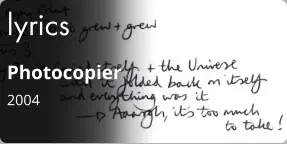
Photocopier
Heart of Tears
Electric Dance
Seedy Pimp
The Outsider
The Golden Age

GENERAL INFO
Gary’s second full-length album, clocking in at a respectable 42 minutes. A limited run was
pressed in July 2004 and sold out within a few months. A digital download was released on May
15th, 2013.
RECORDING VENUE & DATES
27 Maude Terrace, Walthamstow: September 18, 2003 - June 11, 2004
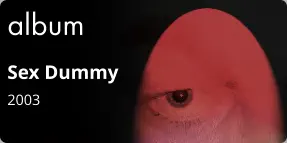
COVER IMAGE
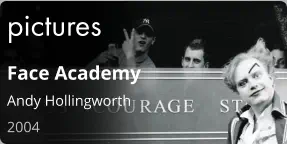
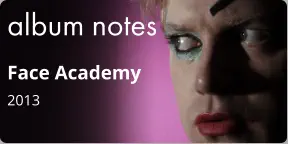
A close-up detail of Gary’s immaculately made-up eye, photographed in a studio somewhere in
South London by the great Andy Hollingworth. I should have chosen a different pic for the
Edinburgh poster - maybe one of these - but this was perfect for the album. Partially inspired by
The Human League’s Dare (which also features close-ups of partial faces, though not quite such
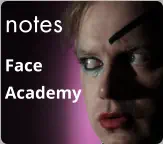
silly ones), but mainly I just thought the eye make-up was so good. Sadly, I’ve forgotten the name
of the woman who did it, but here’s a picture of her in action:
2004
LISTEN/BUY


CD PACKAGING
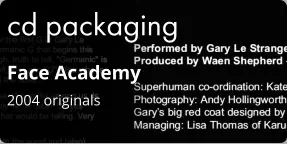
As well as the front cover, I splashed out on a slightly more lavish eight-page booklet for the CD,
which you can view and/or download here. Heavily inspired by the mock-pretentious stuff Paul
Morley used to write for Zang Tuum Tumb, it’s arguably better than the music itself. I can well
imagine some excited soul chuckling away at the packaging, only to be monumentally baffled and
disappointed when they put the disc on.
THE MUSIC
Ten silly electronic pop songs about conflict, misery, cruelty and doubt, sung by an overconfident
man who’s just been given a mandate from the comedy establishment to do whatever he likes.
THE RECORDING PROCESS
The main watchword was pragmatism. There’s far more detail in my extensive notes here, but
basically I’d just won an award at the Edinburgh Fringe and had just less than a year to go back
there with an even better show. This meant making an even better album to go with it. But
because my act was suddenly in demand, I had far less time to do it in. Early experiments were
fruitful but way too time-consuming, so I drafted up a viable plan, creating a sonic template
(loosely based on The Human League’s Mirror Man) that I thought my crappy computer software
could cope with, and forging all the tracks in the exact same way, without deviation.
The result is a surprisingly professional set of ten tracks with a uniform, spartan sound, which all
sound goofily electronic while somehow stubbornly resisting the influence of dance music. It’s still
all made with the same set-up as before, using samples from MTV Music Generator on the
PlayStation2 to create backing tracks which I remixed in Sound Forge and Adobe Premiere, before
overlaying a vocal. In fact, this album’s much purer in that regard - where the first album was full
of sound effects and sampled synth tones, with one track created almost entirely in Fruity Loops,
this second one is virtually all PlayStation. Apart from my own voice and the sound of a printer at
the end of Photocopier, everything you hear on Face Academy was made on a PS2.
The biggest change from Polaroid Suitcase is the voice. One thing I’d learned over the previous
year was how difficult it was to mix vocals with a backing track - especially if you actually wanted
your words to be heard (pretty essential for a comedy song). Turns out it isn’t just a matter of
turning up the volume and involves lots of fiddly technical wizardry. Also massively helps if you
have a decent microphone. My budget still wasn’t too hot but I struck gold with the Studio Projects
C1, which gave me a really great, crisp, warm, upfront sound for just over £200. Fed through an M-
Audio Audio Buddy pre-amp, if that’s the sort of thing you like to know. Can’t tell you how much
easier this made everything to do.
What’s that? You want me to tell you more technical details about how I mixed the vocal track?
Well, if you insist. The new mic didn’t just make the syllables crisper. It also saved me time. On the
first album, I’d swamped a lot of the vocals in delay, which embedded them in the track quite well
but took more time to master. With the new mic, I found I could just add a bit of EQ and
compression but leave it otherwise dry, and it sounded great. This also means you’re not having to
listen to the words rebounding back on themselves all the time, so it’s much easier to hear what
Gary’s saying. And it means you can occasionally punctuate the dryness with a sudden line or
word drenched in reverb, for added dramatic emphasis.
So even though, on the face of it, this is a much simpler piece of work than its predecessor, it’s
technically just a little bit more advanced. My gear might have been a cobbled-together load of
cheap rubbish that no one in their right mind would have used to make a piece of recorded music,
but I was using it to a higher professional standard than I had hitherto managed, and basically as
far as it ever got. After this, I decided to ditch the PlayStation and get some proper gear. And then
all Hell broke loose.
THOUGHTS & FEELINGS
When I wrote the sleeve notes to accompany Face Academy’s digital release in 2013, I said it was
“probably my favourite [Gary Le Strange album]. It came closest to achieving the vision I had in my
head and, at the time, I considered it far superior to its predecessor. The lyrics were cleverer, the
arrangements cleaner, the performance more confident.”
Listening to it now, I feel pretty much the opposite. I mean, yes, it was the most successful in
terms of achieving what I set out to achieve in the time I set out to achieve it. The wordplay’s more
ambitious, it’s technically superior and the singer is a much, much better singer. But I just don’t
like it as much as the other albums. Like the show it accompanied, this album’s more professional
than the first - the guy who made it is so much better at what he’s doing. But the thing he’s doing
just isn’t as good.
The first album does a pretty good job of placing you inside the head of this eccentric dreamer,
who isn’t afraid to show you his dreams. It may lack polish but it’s got positivity and (weirdly for a
guy who sings about how much he likes drawing triangles and raping shop window dummies) it’s
got a lot of heart. And for every pretentious flight of fancy, there’s something waiting round the
corner that’ll bring it right back down to earth. Gary Le Strange might be a weirdo, but he’s a sweet
weirdo who deserves to find a place to be heard.
Face Academy is entirely different. It’s the product of success, made by a man with way more
confidence but far less time to think things through. I can hear the influence of the BBC radio
sketch shows I was working on, resulting in much more professional pieces you have to listen to
and think about, but they rarely ever grab you in the gut. I mean, obviously, it had to be this way -
it’s the situation I was actually in and the album reflects that perfectly. And no doubt it’s still very
original and interesting and creative. But I listened through it just now for the first time in almost a
decade and it only made me laugh twice. I found it hard to care about the things Gary seems to
care about, probably because I’m not really sure what they are. Unlike the earlier Gary, this guy
isn’t really a weirdo - he just says he is. And when you couple that with extended verbal diarrhoea
inspired by the more obscure works of Bowie and ABC, it ends up sounding less than genuine.
No doubt I’ll feel differently again if I’m lucky enough to be here in another ten years, but right
now I’d say approach Face Academy with caution. It’s nowhere near as good as it thinks it is.
BEST TRACK
Photocopier or Seedy Pimp, with maybe What Love Is and Metal Boy as runners up. Most of the
others make me cringe.
--------------------------------------------------
BANDCAMP UPDATE (April 2024)
The 2024 Bandcamp release features several bonus tracks recorded around the same time as the
album, including early versions of Warriors of Style and What Love Is from 2003, three spoken-
word inserts from the live show, and a previously unreleased song called Harlequin, originally
written and recorded for (but rejected from) the second series of BBC Radio 2’s The Day the Music
Died. Gary explains the reasons for the rejection (and what the song is meant to be about) in a
specially-recorded spoken intro, which you can listen to here.




BONUS TRACKS (BANDCAMP ONLY)
Insert: The Lone Dandy
Warriors of Style (2003 version)
Insert: Inside Greedy City
What Love Is (2003 version)
Insert: Who Am I?
Harlequin (with 2024 intro)







FACE ACADEMY




Warriors of Style
What Love Is
Metal Boy
Modern Disguise
Photocopier
Heart of Tears
Electric Dance
Seedy Pimp
The Outsider
The Golden Age
GENERAL INFO
Gary’s second full-length album, clocking in at a
respectable 42 minutes. A limited run was pressed in
July 2004 and sold out within a few months. A digital
download was released on May 15th, 2013.
RECORDING VENUE & DATES
27 Maude Terrace, Walthamstow: September 18,
2003 - June 11, 2004
COVER IMAGE
A close-up detail of Gary’s immaculately made-up
eye, photographed in a studio somewhere in South
London by the great Andy Hollingworth. I should
have chosen a different pic for the Edinburgh poster
- maybe one of these - but this was perfect for the
album. Partially inspired by The Human League’s
Dare (which also features close-ups of partial faces,
though not quite such silly ones), but mainly I just
thought the eye make-up was so good. Sadly, I’ve
forgotten the name of the woman who did it, but
here’s a picture of her in action:
CD PACKAGING
As well as the front cover, I splashed out on a
slightly more lavish eight-page booklet for the CD,
which you can view and/or download here. Heavily
inspired by the mock-pretentious stuff Paul Morley
used to write for Zang Tuum Tumb, it’s arguably
better than the music itself. I can well imagine some
excited soul chuckling away at the packaging, only to
be monumentally baffled and disappointed when
they put the disc on.
THE MUSIC
Ten silly electronic pop songs about conflict, misery,
cruelty and doubt, sung by an overconfident man
who’s just been given a mandate from the comedy
establishment to do whatever he likes.
THE RECORDING PROCESS
The main watchword was pragmatism. There’s far
more detail in my extensive notes here, but basically
I’d just won an award at the Edinburgh Fringe and
had just less than a year to go back there with an
even better show. This meant making an even better
album to go with it. But because my act was
suddenly in demand, I had far less time to do it in.
Early experiments were fruitful but way too time-
consuming, so I drafted up a viable plan, creating a
sonic template (loosely based on The Human
League’s Mirror Man) that I thought my crappy
computer software could cope with, and forging all
the tracks in the exact same way, without deviation.
The result is a surprisingly professional set of ten
tracks with a uniform, spartan sound, which all
sound goofily electronic while somehow stubbornly
resisting the influence of dance music. It’s still all
made with the same set-up as before, using
samples from MTV Music Generator on the
PlayStation2 to create backing tracks which I
remixed in Sound Forge and Adobe Premiere,
before overlaying a vocal. In fact, this album’s much
purer in that regard - where the first album was full
of sound effects and sampled synth tones, with one
track created almost entirely in Fruity Loops, this
second one is virtually all PlayStation. Apart from my
own voice and the sound of a printer at the end of
Photocopier, everything you hear on Face Academy
was made on a PS2.
The biggest change from Polaroid Suitcase is the
voice. One thing I’d learned over the previous year
was how difficult it was to mix vocals with a backing
track - especially if you actually wanted your words
to be heard (pretty essential for a comedy song).
Turns out it isn’t just a matter of turning up the
volume and involves lots of fiddly technical wizardry.
Also massively helps if you have a decent
microphone. My budget still wasn’t too hot but I
struck gold with the Studio Projects C1, which gave
me a really great, crisp, warm, upfront sound for
just over £200. Fed through an M-Audio Audio
Buddy pre-amp, if that’s the sort of thing you like to
know. Can’t tell you how much easier this made
everything to do.
What’s that? You want me to tell you more technical
details about how I mixed the vocal track? Well, if
you insist. The new mic didn’t just make the syllables
crisper. It also saved me time. On the first album, I’d
swamped a lot of the vocals in delay, which
embedded them in the track quite well but took
more time to master. With the new mic, I found I
could just add a bit of EQ and compression but
leave it otherwise dry, and it sounded great. This
also means you’re not having to listen to the words
rebounding back on themselves all the time, so it’s
much easier to hear what Gary’s saying. And it
means you can occasionally punctuate the dryness
with a sudden line or word drenched in reverb, for
added dramatic emphasis.
So even though, on the face of it, this is a much
simpler piece of work than its predecessor, it’s
technically just a little bit more advanced. My gear
might have been a cobbled-together load of cheap
rubbish that no one in their right mind would have
used to make a piece of recorded music, but I was
using it to a higher professional standard than I had
hitherto managed, and basically as far as it ever got.
After this, I decided to ditch the PlayStation and get
some proper gear. And then all Hell broke loose.
THOUGHTS & FEELINGS
When I wrote the sleeve notes to accompany Face
Academy’s digital release in 2013, I said it was
“probably my favourite [Gary Le Strange album]. It
came closest to achieving the vision I had in my
head and, at the time, I considered it far superior to
its predecessor. The lyrics were cleverer, the
arrangements cleaner, the performance more
confident.”
Listening to it now, I feel pretty much the opposite. I
mean, yes, it was the most successful in terms of
achieving what I set out to achieve in the time I set
out to achieve it. The wordplay’s more ambitious, it’s
technically superior and the singer is a much, much
better singer. But I just don’t like it as much as the
other albums. Like the show it accompanied, this
album’s more professional than the first - the guy
who made it is so much better at what he’s doing.
But the thing he’s doing just isn’t as good.
The first album does a pretty good job of placing
you inside the head of this eccentric dreamer, who
isn’t afraid to show you his dreams. It may lack
polish but it’s got positivity and (weirdly for a guy
who sings about how much he likes drawing
triangles and raping shop window dummies) it’s got
a lot of heart. And for every pretentious flight of
fancy, there’s something waiting round the corner
that’ll bring it right back down to earth. Gary Le
Strange might be a weirdo, but he’s a sweet weirdo
who deserves to find a place to be heard.
Face Academy is entirely different. It’s the product of
success, made by a man with way more confidence
but far less time to think things through. I can hear
the influence of the BBC radio sketch shows I was
working on, resulting in much more professional
pieces you have to listen to and think about, but
they rarely ever grab you in the gut. I mean,
obviously, it had to be this way - it’s the situation I
was actually in and the album reflects that perfectly.
And no doubt it’s still very original and interesting
and creative. But I listened through it just now for
the first time in almost a decade and it only made
me laugh twice. I found it hard to care about the
things Gary seems to care about, probably because
I’m not really sure what they are. Unlike the earlier
Gary, this guy isn’t really a weirdo - he just says he is.
And when you couple that with extended verbal
diarrhoea inspired by the more obscure works of
Bowie and ABC, it ends up sounding less than
genuine.
No doubt I’ll feel differently again if I’m lucky enough
to be here in another ten years, but right now I’d say
approach Face Academy with caution. It’s nowhere
near as good as it thinks it is.
BEST TRACK
Photocopier or Seedy Pimp, with maybe What Love
Is and Metal Boy as runners up. Most of the others
make me cringe.
--------------------------------------------------
BANDCAMP UPDATE (April 2024)
The 2024 Bandcamp release features several bonus
tracks recorded around the same time as the album,
including early versions of Warriors of Style and
What Love Is from 2003, three spoken-word inserts
from the live show, and a previously unreleased
song called Harlequin, originally written and
recorded for (but rejected from) the second series of
BBC Radio 2’s The Day the Music Died. Gary explains
the reasons for the rejection (and what the song is
meant to be about) in a specially-recorded spoken
intro, which you can listen to here.
BONUS TRACKS (BANDCAMP ONLY)
Insert: The Lone Dandy
Warriors of Style (2003 version)
Insert: Inside Greedy City
What Love Is (2003 version)
Insert: Who Am I?
Harlequin (with 2024 intro)